Thakali Khana Set (The Mustang Highland Daal Bhat)
The Thakali khana set, Nepal's most famous regional thali, refined over centuries by the Thakali people of the Kali Gandaki valley. Multiple curries, fresh greens, dried meat, yogurt, and pickles, all built around dal bhat.
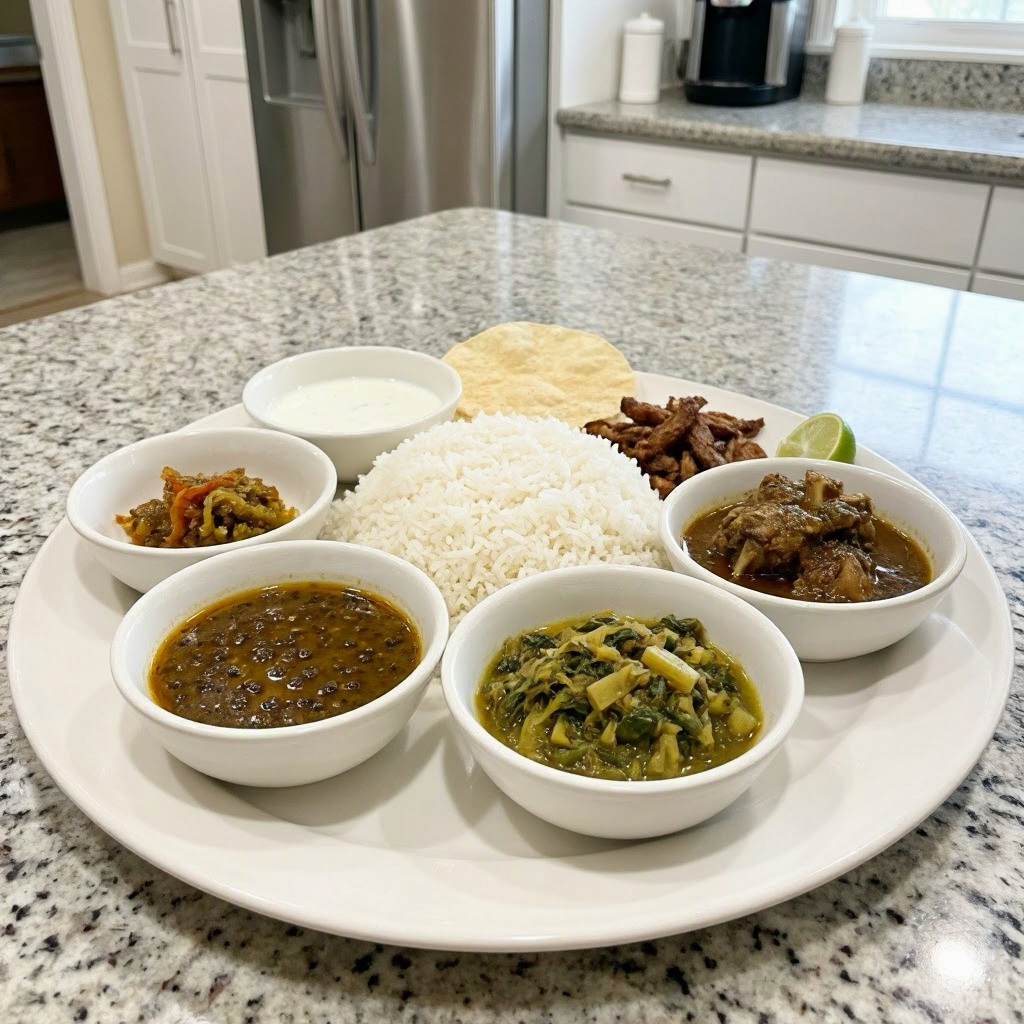
The Thakali khana is the apotheosis of daal bhat, Nepal’s foundational meal transformed into an art form by the Thakali people of Mustang and the Kali Gandaki river valley. For centuries, the Thakali were traders and herders moving goods between Tibet, India, and the Kathmandu Valley along the salt route through the deepest gorge in the world. Their cuisine reflects that high-altitude trader’s life: every ingredient chosen for sustenance, flavor, and keeping power, every meal generous without being wasteful. What emerged is not sparse but abundant, a khana with five to seven distinct components, each precise, each essential.
What separates a Thakali khana from an ordinary daal bhat? Volume without waste, intensity without excess. The rice is freshly steamed and fluffy; the daal is thick and deeply flavored (often kalo daal, the dark, earthy black lentil); the tarkari (vegetable curry) changes with the season but is always abundant; meat (typically khasi, gelded goat, or chicken) is tender and bone-in. Yogurt, gundruk, papad, multiple achars, and sukuti (dried meat) layer texture upon texture. Plates are refilled, bhat and daal are bottomless in any honest Thakali bhatti, until the guest waves it off.
This page is a guide to assembling a Thakali khana at home, with links to each component recipe so you can build the platter dish by dish over a weekend.
What goes on the platter
Rice (bhat)
Plain steamed long-grain or basmati rice, generous, freshly cooked, served first and refilled. Some elevated bhattis offer jeera bhat (cumin-tempered rice) or rice cooked with a spoonful of ghee. The mound is large; the Thakali do not ration rice.
Daal, the soul of the platter
The classic Thakali version is kalo daal, whole black lentils slow-simmered until creamy, then jhanne-tempered with ghee, cumin, garlic, and dried red chili. Thicker than the lighter masuro daal of the lowlands, it is meant to be ladled over the rice in generous spoonfuls. (Our daal bhat recipe is the masuro version; for a Thakali set, simply substitute whole black lentils, same technique, longer cooking time.)
Seasonal tarkari (vegetable curry)
Always at least one, sometimes two, vegetable curries, depending on the season and altitude. In the high villages of Mustang you might get aalu cauli (potato and cauliflower), spiced potato with fenugreek (aloo ko tarkari), seasonal squash, or a mixed-vegetable curry. Whatever it is, it is bloomed in mustard oil with cumin and turmeric and served abundantly.
Masu (meat curry)
The luxury course. Typically khasi ko masu, gelded goat slow-stewed bone-in until the meat falls off, or chicken gravy. The gravy is rich, dark, mustard-oil-based, and assertive. The meat is left in chunks, not shredded; bones are sucked clean.
Sukuti, dried, spiced meat
Strips of dried yak, water buffalo, or mutton, briefly fried in mustard oil with chili and garlic until they soften slightly at the edges. Intensely flavored, eaten slowly, in small bites, between mouthfuls of the milder dishes. A high-altitude protein preservation technique that became a delicacy.
Saag, quickly cooked greens
Mustard greens or spinach, lightly sautéed in mustard oil with garlic and a dried red chili. Cleanses the palate between bites of richer items.
Gundruk, fermented leafy greens
Often served as a small dry pickle (gundruk ko achar) on the side, or as a small bowl of the soup. Sun-fermented mustard greens are the signature taste of Himalayan Nepal, sour, salty, mineral, and the marker of authentic mountain cuisine.
Achar medley
At least three pickles, the rule, not the exception. Common ones: mooli achar (sharp tangy radish), lapsi achar (Nepali hog plum, sweet-sour), golbheda achar (fresh tomato pickle with toasted sesame), and a chili-based fresh pickle. Each pickle has a job, cutting fat, lifting acid, adding sweetness.
Dahi (yogurt) or mahi (buttermilk)
A small bowl of cool, plain set yogurt or thin buttermilk. Cooling against the chili, settling on a heavy meal, aids digestion at altitude.
Papad
A thin lentil wafer, fried or roasted, for the satisfying crunch that breaks up the otherwise-soft components of the platter.
Optional: dessert
A small bowl of kheer (rice pudding), or simply fresh seasonal fruit, apples and apricots from the high valleys are famous in Mustang.
How to assemble and serve
The khana arrives on a single round metal plate (tapari) divided into compartments, rice in the center, the curries and pickles around the edge. Sometimes it is served on a fresh banana leaf laid over the plate.
The customary order of eating, in any honest Thakali bhatti:
- Start with rice and daal. Pour daal over a portion of the rice, mix with the fingers, eat.
- Add a spoonful of tarkari. Some prefer to mix it in; some eat it on the side.
- Bite into the meat curry. Pull a chunk of bone-in meat into the rice, suck the bone, return to the plate.
- Cleanse with saag and gundruk. A nibble of greens between bites of richer items.
- Reach for the achar. Small dabs, pickles are intense and meant in small doses.
- Nibble at the sukuti slowly throughout. Never the centerpiece, always the accent.
- Crack the papad for crunch whenever the plate gets too soft.
- Finish with a spoon of yogurt. Cool, settle, breathe.
Refills of rice and daal are offered repeatedly, refusing once means not yet; refusing twice means I’m full. A Thakali host considers it a failure if a guest leaves still hungry.
Drinks: Thakali bhattis serve chyang (rice beer, milky and slightly sour), or sometimes aila (a smoother high-altitude rice spirit). After the meal, cha, Tibetan-style butter tea or simple milk tea, is offered.
When the khana is served
- Daily, every day: Lunch and dinner at every Thakali bhatti from Pokhara to Mustang. There is no occasion needed.
- Lhafewa (Thakali New Year, late September–October): the most ceremonial khana of the year
- Toranlha (ancestral worship): family lineage ceremonies marked with the most generous khana possible
- Trek rest days: a restorative meal after high-altitude exertion, the reason every Annapurna trekker remembers their first Thakali khana
- Family celebrations: births, weddings, home-blessing rituals
Where to eat the real thing in Nepal
- Mustang District (Thak Khola region): Tukuche and Marpha, the historic heart of Thakali territory. Small family bhattis in either village serve khana with reverent attention to authenticity. Marpha is also famous for apple brandy.
- Jomsom: the gateway to Mustang; multiple Thakali bhattis cluster around the airstrip.
- Pokhara: Thakali Bhanchha Ghar and Thakali Kitchen are reliable, family-run establishments, not as pure as a village bhatti but very good.
- Trekking routes: any bhatti along the Annapurna Circuit, Annapurna Sanctuary, or Mustang trek run by a Thakali family will serve a proper khana. Ask the lodge owner if they are Thakali. If yes, order the khana and skip the menu.
- Kathmandu: Thakali restaurants in Thamel, Lazimpat, and Jhamsikhel. Quality varies; the family-run places are the best.
Building the khana in your own kitchen
A full Thakali khana is a weekend project the first time you attempt it, and a relaxing Sunday lunch after that. Most components scale comfortably for four to six people.
A weekend timeline:
- Day before: Soak the lentils for the daal. Make the gundruk ko jhol (or just the dry gundruk side). Whisk a fresh batch of yogurt for dahi.
- Day of, 2 hours before: Start the khasi ko masu or chicken gravy, slow stews need time. Get the daal simmering.
- 45 minutes before: Cook the rice. Make the aalu cauli or whichever tarkari you chose.
- 15 minutes before: Quickly sauté the saag. Bloom the sukuti in hot mustard oil with chili. Crisp the papad.
- At the table: Arrange everything on the largest plates you own, with rice in the center. Open a beer (Tuborg if you want to be authentic, the most-poured beer in any Thakali bhatti). Refill the rice and daal generously. Take your time.
The philosophy
A Thakali khana is not about excess, it is about sufficiency met with joy. In the harsh, high-altitude world where the Thakali live, food is neither taken for granted nor scarce. It is abundant, varied, and respectful to the grains, animals, and earth that produced it. When you eat a khana at 8,600 feet in Marpha, served by a host whose family has lived in that village for thirty generations, you are not just eating lunch. You are participating in a centuries-old negotiation between humans and one of the most demanding environments on earth, and the meal is the proof that the negotiation has been won, again, today.